Most people see the app. The screens. The prototype that shows up on LinkedIn with a “shipped it 🚀” caption.
What they don’t see is the work that makes those screens inevitable rather than arbitrary: weeks of structured chaos where opinions, constraints, user needs, and market reality get forced into something a team can actually build.
At Nimble, every engagement runs as a loop: Strategize → Design & Build → Learn & Grow. This piece is an inside look at the first phase: discovery. And the part many teams miss: discovery is not a one‑time kickoff artifact. The Learn & Grow phase generates the data, tensions, and questions that feed straight back into the next round of strategic thinking.
That’s the flywheel.
The problem with “strategy” in digital
In a lot of digital work, “strategy” looks like this:
- A senior person writes a brief
- A junior person turns it into a deck with too many slides
- There’s a workshop with Post‑its
- Three weeks later a 60‑page PDF lands that nobody reads
The builders get a Figma link and a prayer.
We don’t do that.
At Nimble, strategy is a compression engine. We take a mess of stakeholder opinions, business constraints, user needs, and market context and compress it into something a team can build. In weeks, not months.
AI changes the game here, but not by replacing thinking. It removes the bottleneck between having information and doing something with it.
The three lenses (run in parallel)
Every engagement moves through three lenses: simultaneously, not sequentially.
- Desirability: Do people actually want this? What are the real jobs-to-be-done and moments that matter?
- Feasibility: Can we build it? What’s realistic given the architecture, constraints, and timeline?
- Viability: Does the business logic hold? Where’s the revenue, the moat, the path to sustainability?
Many teams treat these like separate workstreams that merge at the end. We run them in parallel from day one, in constant dialogue, because a brilliant concept that can’t be built is theater, and a technically feasible product that nobody wants is waste.
AI is the engine, not the decoration
To understand how we can compress months of work into a few weeks, you need to understand the toolkit, because the tools are not just a nice-to-have, but truly structural.
- Claude as a thinking partner for synthesis, modeling, and deep research.
- Perplexity for fast, current data: market sizes, competitor moves, regulatory shifts.
- Notion AI as living memory: interviews, contradictions, evolving hypotheses.
- V0 + Figma as strategy tools, not just design tools so early concepts can be made tangible, tested, and refined.
The result is a continuous loop: research feeds synthesis, synthesis feeds prototypes, prototypes create new questions, and those questions feed back into research.
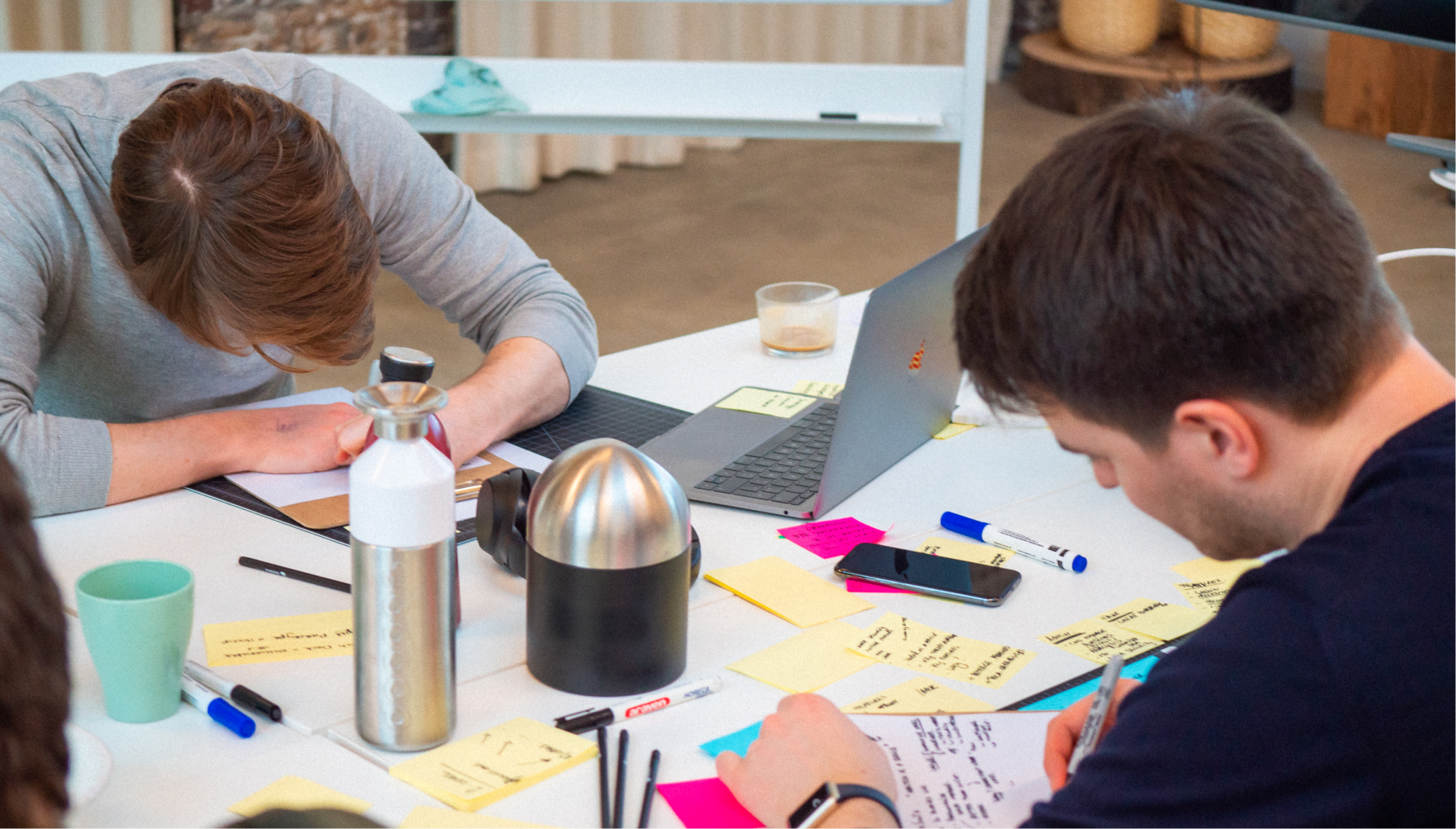
The Discovery Track: Strategize in action
We call this a discovery track for a reason. It’s a structured sprint to discover what’s worth building, for whom, and why.
Before Week 1: the pre‑game 🥂
This is the part nobody talks about and where the real magic starts.
Before the kickoff, before the first stakeholder interview, we’ve usually already done more strategic work than most agencies do in their entire “discovery phase.”
1) Deep research, AI‑accelerated
We walk into day one with hypotheses, not a blank page. Macro forces, challenger models, what incumbents are doing, where the strategic fault lines are mapped upfront.
2) Competitive and business model analysis
We deconstruct the business before we ask someone to explain it. Revenue streams, margin structure, defensible assets, where the model is being commoditized, and what that implies for the next bets.
3) Early (working) prototypes
This is where most stakeholders do a double take.
We prototype to research. We build to think.
Rough V0 prototypes are not “design.” They’re thinking tools. Provocations. A way to replace abstract discussion with real reaction.
Week 1: desirability deep dive
Week one is about people: stakeholder interviews, user insights, and relentless synthesis.
Typically, we speak with 10–15 stakeholders across product, business, technology, and operations. Each carries a different mental model of who the product is for and what success means.
Here’s what changes when AI is woven into the process:
- Every interview transcript goes into Notion.
- After each conversation, Notion AI updates a living briefing. Not just what was said, but how the picture is shifting.
- Contradictions surface early. Different definitions of the target user. Different beliefs about what’s driving demand. Misalignment between product intuition and business assumptions.
- Synthesis is continuous. By the end of the week, we don’t have a pile of transcripts. We have a pressure‑tested understanding.
And in parallel, the prototypes evolve in real time. A critical user moment gets mentioned at 10 AM and by that afternoon, there is a tangible concept to react to.
Week 2: viability and feasibility converge
Week two is where the three lenses fully converge.
On the viability side, we stress-test the business logic: value chains, unit economics, growth constraints, and the assumptions that silently break strategies.
On the feasibility side, the tech lead runs a parallel track: architectural constraints, platform realities, what can be shipped now versus what requires deeper investment.
By the time something survives into Week 3, it has been validated against:
- Do people want it?
- Does it make business sense?
- Can we build it?
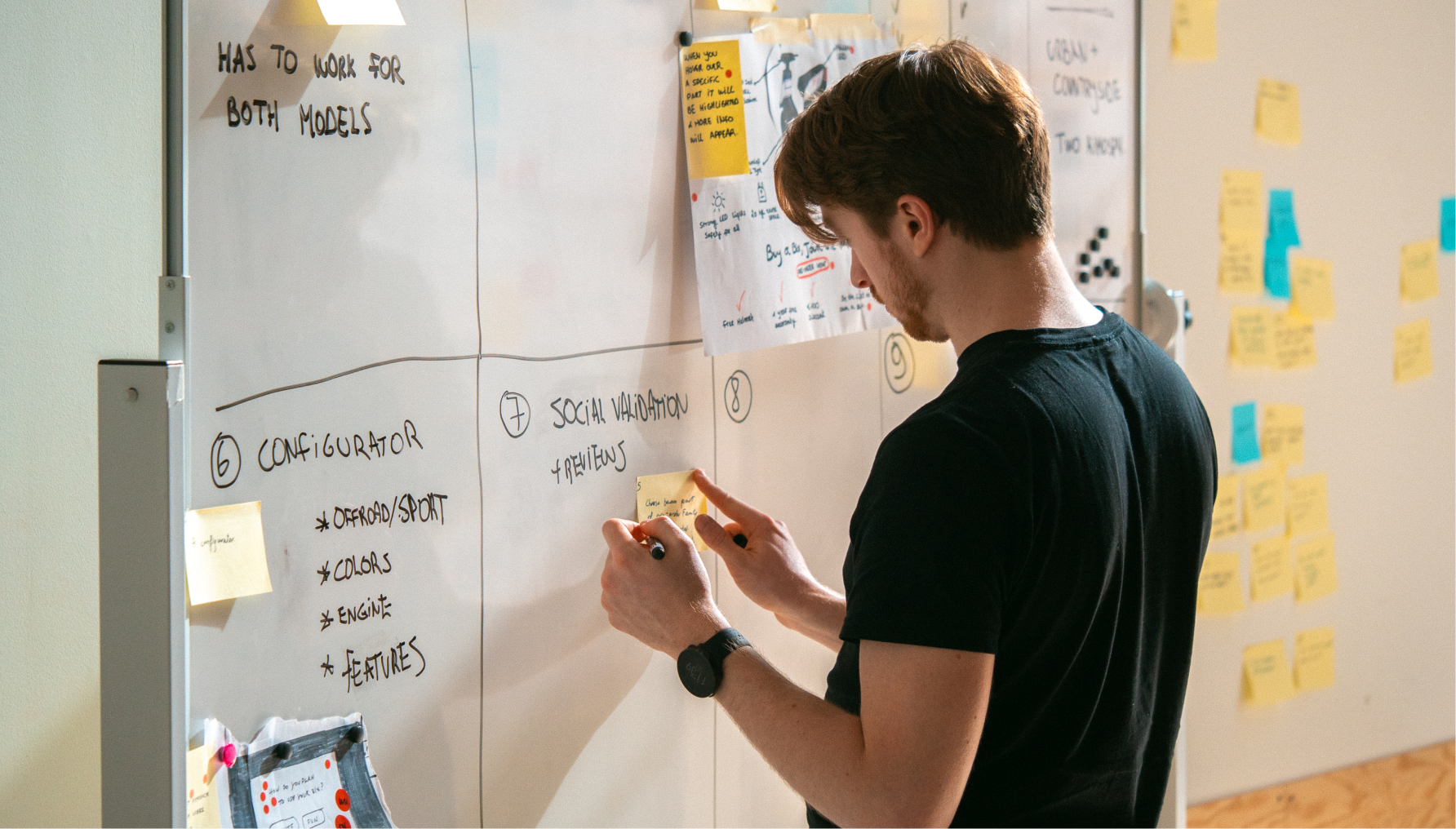
Week 3: convergence and delivery
By week three, we have:
- A validated (or killed) hypothesis about the opportunity
- A living synthesis of stakeholder perspectives, contradictions, and decisions
- Conceptual prototypes that have already survived contact with reality
- Financial and business model analysis grounded in real data
- A feasibility assessment that shapes what we recommend
The output is not a 60‑page deck.
It’s a package the build team can execute:
- A strategic narrative grounded in evidence
- Prioritized opportunities with rationale
- Validated prototypes (V0 + Figma), not abstract slides
- A decision log capturing what we chose and why

The prompt trail: what the AI‑assisted work actually looks like
We rarely show this part, but it matters: AI doesn’t create good strategy. The quality of the work still depends on the questions.
Deep research prompts are specific: industry context, the strategic shift being explored, the macro forces at play, the challenger landscape, and what the company has already done that changes the odds.
Business model deconstruction is explicit: filings, revenue composition, margin structure, partnership layers, a clear view of what’s defensible and what’s being commoditized.
Living synthesis prompts keep the work honest: what changed, what contradictions emerged, which hypotheses got stronger, which got weaker.
AI compresses the talent stack, but judgment still determines the value.
Why this matters
Two reasons.
1) Strategy without execution is just a deck.
If you get the framing wrong, you build the wrong thing efficiently. If you get the framing right but execute poorly, you wrote an expensive story. AI compresses both sides: it’s now possible to think faster and ship faster, but only if strategy and execution stay tightly integrated.
2) This way of working requires a specific kind of person.
Someone who can move between deep research, stakeholder empathy, strategic synthesis, financial modeling, and rapid prototyping ... sometimes in the same day. Someone who uses AI as a thinking partner, not a replacement for thinking.
The uncomfortable truth
A lot of “strategy” in the agency world is theater.
AI‑native strategy makes it harder to hide behind process. When research that used to take two weeks takes two hours, and prototypes that used to take two weeks take an afternoon, the only thing left is the quality of the thinking and how quickly it becomes something real.
The tools DON'T do the strategy. But they DO strip away every excuse for not doing it well.
