Last month I gave a 45-minute session to the leadership team of a large Belgian B2B service company. The first slide held one question: how does a B2B service stay relevant when everything changes?
We hear that question in almost every boardroom lately. Social secretariats, hosting groups, accountants, insurers. Their expertise has never been more valuable, or more at risk.
We turned that session into a free white paper (get it at the bottom). This post is the short version, and it hangs on two words:
- Agentic is what your customer experiences: a service that answers, acts and follows up.
- AI-native is how your organisation works to make that possible.
The first one doesn’t last without the second.
Three lenses, all moving at once
We look at innovation through three lenses: the customer, the business and the technology. Usually one of them moves at a time. This year all three shifted together.
The customer. People now expect every service to be instant, proactive and personal. They compare you to the assistant in their pocket, not to your competitor. Read the reviews of almost any B2B service and you’ll find the same complaints: slow replies, the same documents asked for twice, generic advice. That’s a delivery problem, and the knowledge to fix it is usually already in the building.
The business. A new wave of AI-native companies sells the work done, not the tool. In Belgium alone, there’s a startup that runs onboarding and payroll changes from a single message, one that shows employees what a benefit does to their net pay before they choose, and an accounting firm that bundles bookkeeping, payroll and advice into one fixed price. All three sit on top of services someone else delivers. Whoever owns the conversation with the customer owns the relationship.
And they move fast. Lovable went from $1M to $100M in annual revenue in eight months. In the first eight months of 2026, we counted 336 updates in their release notes. A traditional release cycle gets you two.
The technology. In 2023 we got answers in a chat. In 2024 AI started taking actions. In 2025, open standards like MCP made one agent available in every channel. In 2026 the interface builds itself inside the conversation, and an assistant can suggest your service for a question that never mentions your name.
The building blocks now arrive in months, for everyone. What sets you apart is how fast your organisation learns around them.
That’s why the line we closed this part of the session with still stands: now is the time to be Nimble. Or become obsolete.
The tip of the iceberg
Yes, an iceberg. I know it’s a bit corny. It’s also true. 😅
The agentic experience your customer sees is the tip: one assistant, one conversation, in ChatGPT, your app or WhatsApp. Below the waterline sits an AI-native organisation with many assistants doing the real work. An expert workbench where every case arrives prepared. Knowledge and corrections. Next best actions. Evaluations and traces.
The agentic side earns the trust. The AI-native side earns the margin.
KBC shows both sides well. Kate lives in the mobile app for customers and in the daily work of KBC’s own people. On the outside, she solves around 75% of questions on her own. On the inside, employees picked up 656,000 leads from Kate in a single quarter. The customer sees one side; the efficiency lives on the other.
That’s also why we tell every client to work their way back. Become AI-native internally first, with an assistant your own experts use. Earn trust there, with loops running and gates in place. Only then put the agentic experience in front of customers.
Three ingredients and one foundation
Below the waterline, three things make an organisation AI-native.
1. Agents, embedded. Not a chatbot on the side, but agents inside every function, with the tools, data and mandate to do real work. A business owner writes “my invoice emails aren’t arriving”. The agent reads the account, the DNS records and the mail logs, prepares the fix, and hands an expert a case that’s already diagnosed.
At team.blue we built exactly that. Their Business Sidekick now handles 84% of conversations at Combell, with 83% customer satisfaction. The experts stayed. They just spend their time on judgement now, instead of gathering context.
2. Self-improving loops. Every conversation is evidence. The system spots a recurring gap, proposes a fix and tests it before anyone sees it. A low-risk fix ships on its own. A consequential change waits for a person.
3. Oversight. Experts set the boundaries, approve what matters and own the judgement. Before an agent changes anything important, three checks run as code. The fourth is a human approval, and the agent can’t skip any of them.
Then comes the uncomfortable part. MIT’s NANDA research found that 95% of enterprise GenAI pilots show no measurable P&L impact. In our experience, the model is rarely what breaks. The pilot sits in a silo, nobody owns the agents after go-live, or a chatbot gets bolted onto the website while the way the organisation works stays exactly the same.
So the foundation is people. One AI-native team, embedded in every division, whose job is to turn opportunities into agentic experiences and keep improving them. Keep those teams small: Brooks’s law has never been more relevant. Three people have 3 lines of communication between them, twelve people have 66.
We started this at Nimble ourselves at the beginning of 2026. Our Internal AI Lead was hired for training, coaching and rituals, not for code. On purpose.
Where to start: one journey
Pick the journey where the questions repeat and the cost to serve lives. Give it one owner. Embed the agent in the expert’s workflow from day one. And put traces, evaluations and expert approvals in place before launch, not after.
Want to know where your team stands? Here’s the self-check from the white paper. Tick only what’s true today, not what’s on the roadmap.
- A customer can get a personal answer in minutes, not days.
- We know the ten questions customers ask most, and what each one costs us.
- At least one agent works inside a function, not on the side.
- Every agent conversation is traced and evaluated.
- We wrote down where an agent may act, prepare, or never act.
- Someone owns the agents after go-live.
Fewer than four? Then the white paper’s 30-minute workshop is a good next step. Three tables, ten minutes each, on discovery, gates and the loop, and you leave the room with one journey to build first.
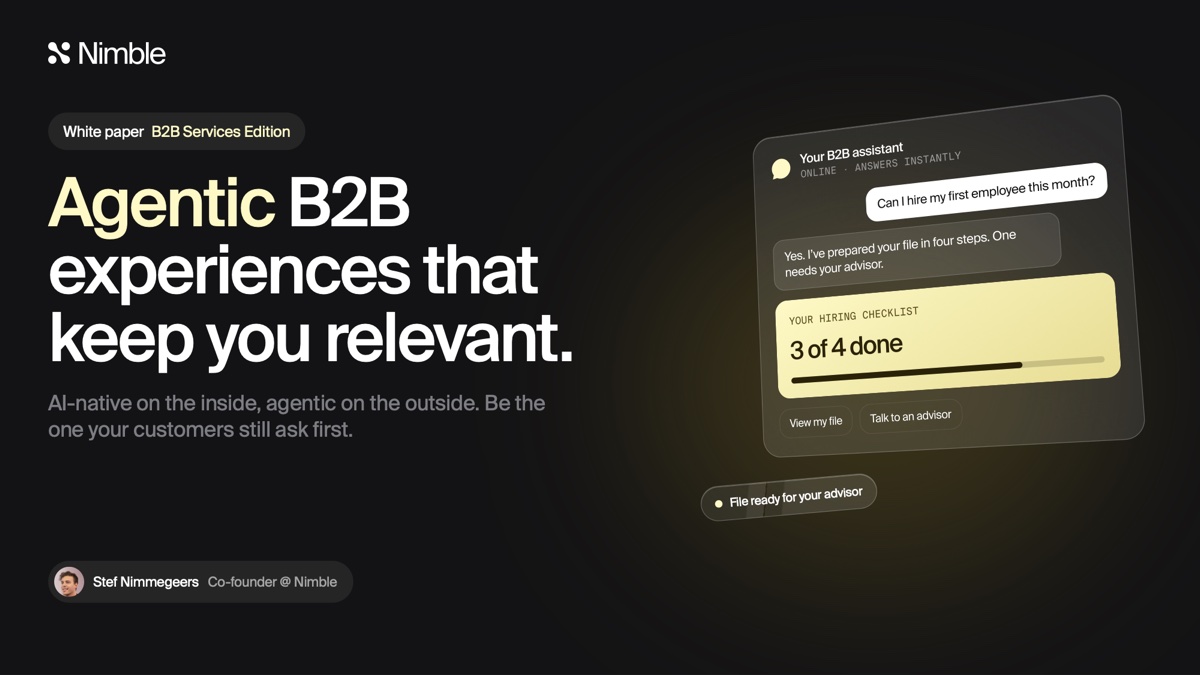
The full framework, the KBC Kate case, the six-question self-check and a 30-minute workshop for your leadership team.
No spam, unsubscribe anytime. Privacy policy.
Welcome back! Here’s your copy. Page 31 is the workshop. Steal it.
Download the PDF (1.8 MB)And if you’d rather have a second opinion, we run this check with leadership teams in a single session. Let's talk!
Which question do your customers ask that only you can fully answer?
